
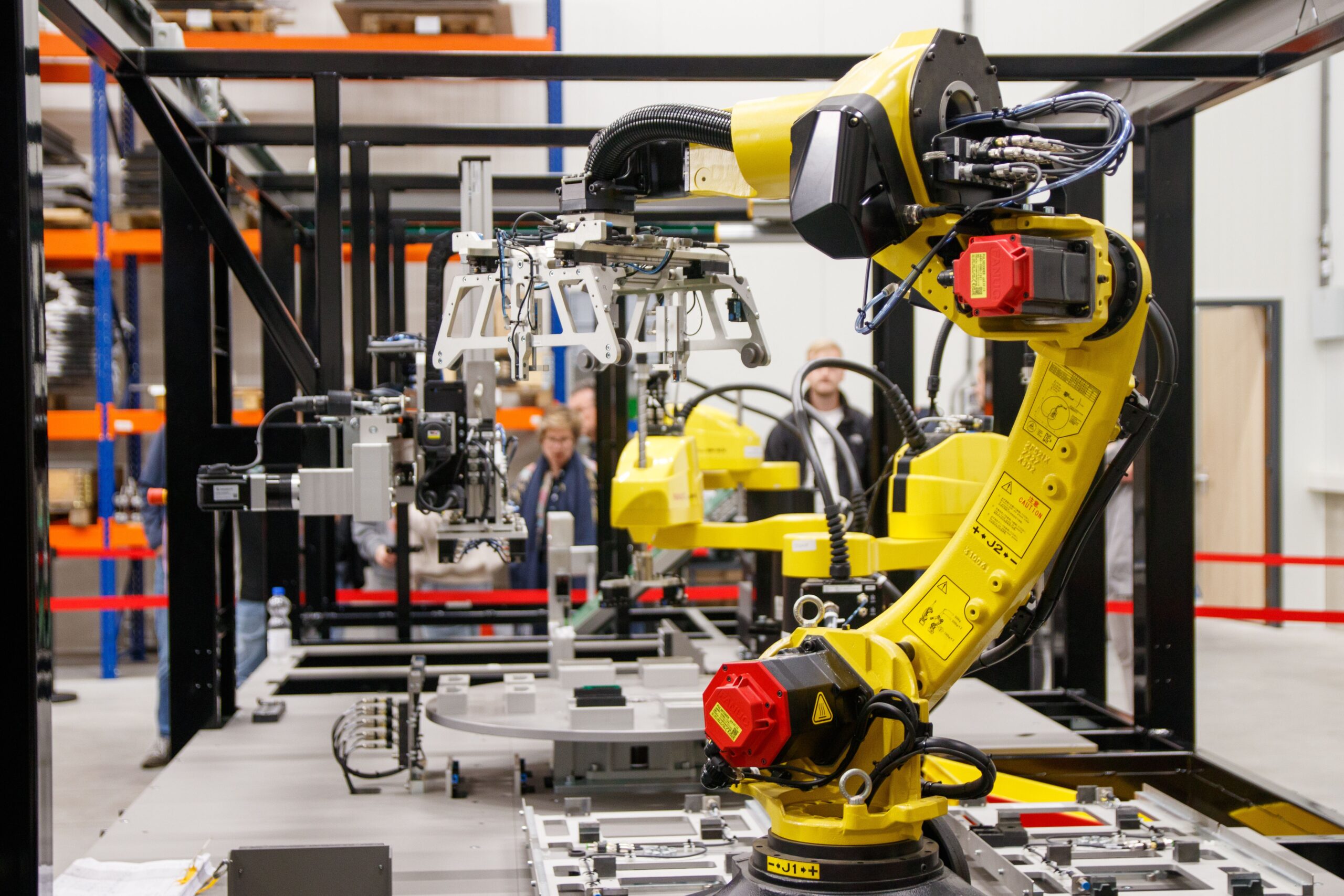
Three separately reported milestones converged on China’s AI-hardware sector this month: a record-breaking robotics IPO, a memory chipmaker’s breakout into NAND’s global top three, and an open-sourced alternative to Nvidia’s software ecosystem.
None of these stories were reported as one story. Each broke on its own wire, from its own beat (robotics, semiconductors, enterprise software) days or weeks apart. Read together, they describe something none of them claims individually: a hardware base assembling itself in parallel, across layers that don’t usually share a headline.
Robotics: The Storm and the Accumulation
Markets read robotics the way they read weather: by what’s loud that week, not by what’s accumulating underneath.
Unitree, the Hangzhou-based humanoid-robot maker, raised $905 million selling 10% of its enlarged capital in a Shanghai listing so oversubscribed by retail investors (more than 8,000 times, a STAR Market record) that Reuters puts its implied valuation at roughly 60 billion yuan, or about 219 times projected 2025 earnings (Reuters, Aug. 14).
The company reported 1.7 billion yuan in 2025 revenue and is already profitable, with more than 40% of sales coming from overseas; backed by Tencent, Alibaba, Meituan, Ant Group, China Mobile, and, notably, DeepSeek, which put in 140.8 million yuan ($20.8 million) for a 2.31% stake as the two Hangzhou companies plan to collaborate on motion control and embodied intelligence (Reuters, Aug. 6). Reuters also notes Unitree’s private-market shares were trading well above the IPO price even as analysts flagged a gap between sector hype and the company’s still-limited number of mature factory-floor applications (Reuters, Aug. 14).
But while the storm gets the headline, the accumulation is happening at AGIBOT, the Shanghai-based rival.
Omdia’s 2026 market-radar data puts AGIBOT at 5,168 humanoid shipments in 2025 against Unitree’s 4,200: 39% of the entire 13,318-unit global market (Omdia, 2026). AGIBOT’s own account says its 15,000th robot rolled off the line in June 2026 (roughly a year to go from 1,000 to 5,000 units, then three months from 5,000 to 10,000, then on to 15,000) alongside some 100 cumulative hours of livestreamed factory operation, during which its G2 unit did live quality-inspection work in a tablet mass-production line, not a lab demo (AGIBOT, 2026).
“As the industry moves from proof of concept toward real-world application, AGIBOT will continue to bring robots into more real-world scenarios and advance the industrialization of embodied AI through scaled delivery and deployment.”
— Yao Maoqing, AGIBOT executive (AGIBOT, 2026)
One company is being priced. The other is being deployed.
Both things can be true, and neither cancels the other; Unitree’s IPO demand is a real capital-markets signal, AGIBOT’s shipment lead is a real production signal.
Memory: Two Sovereignty Stories and One Scarcity Story
The memory story is quieter and, by the numbers, more consequential.
YMTC, the state-linked NAND flash producer, took 14% of global NAND bit shipments in Q2 2026 (per Counterpoint data reported by Tom’s Hardware) moving into the global top three for the first time, behind Samsung (25%) and SK hynix (22%), on 22% year-over-year growth. The demand mix shifted with it: enterprise SSDs, the storage class AI servers lean on, rose from 26% to 48% of all NAND bits shipped in a year (Tom’s Hardware).
One caveat worth keeping in the frame: shipment share isn’t revenue share; YMTC remains far less exposed to high-margin enterprise SSDs, partly because US trade restrictions still limit its access to Western enterprise buyers (Tom’s Hardware). Earlier Reuters reporting on the company’s physical buildout gives the shipment number its context: YMTC currently runs two fabs at roughly 200,000 wafers/month combined, with three more planned at 100,000 wafers/month each, the third Wuhan facility expected online this year using more than 50% domestically sourced equipment (Reuters, Apr. 14).
CXMT, the DRAM counterpart to YMTC’s NAND position, posted 50.8 billion yuan in Q1 2026 revenue — up 700% year-over-year — swinging to a 25 billion yuan profit from a 1.6 billion yuan loss twelve months earlier, while holding roughly 7.7% of 2025 global DRAM share as the world’s fourth-largest maker (Reuters, Jun. 29). It backed that growth with a $2.94 billion, three-to-five-year DRAM supply agreement with Tencent and, subsequently, a $8.6 billion Shanghai IPO; briefly Asia’s largest offering of 2026 and China’s largest semiconductor A-share listing (Reuters; Yahoo Finance / Reuters). CXMT’s Hefei and Beijing fabs run around 300,000 wafers/month combined, with expansion plans aimed at 600,000.
Neither number above is a forecast. Both are shipped, priced, and settled.
And on the other side of that same ledger sits SK hynix, the South Korean memory incumbent that’s been supplying the world’s AI buildout since well before either Chinese firm reached scale. We pointed out in an earlier in-depth report that SK hynix is one IPO doing more work than an entire sector’s worth of listings.
Its 2025 operating profit hit 47 trillion won (~$31 billion), and first-half 2026 capital spending jumped 72.7% year-over-year to 18.3 trillion won (~$12.8 billion) (Tech in Asia). CEO Kwak Noh-jung told Reuters he expects 2027 to be the industry’s worst-ever memory shortage, with demand outrunning supply capacity into the next decade, and said the company is weighing new fab sites in the US, Japan, and Southeast Asia:
“Our customer demand continues to go up, while our capacity has limitations.”
— Kwak Noh-jung, CEO, SK hynix (Reuters, Jul. 10)
Two hardware-sovereignty threads and one demand-side scarcity thread, occupying the same six months, are not contradictory. They’re the same shortage, read from opposite sides of the supply curve.
| Company | Memory type | Reported development |
|---|---|---|
| YMTC | NAND / flash | 14% of Q2 2026 global NAND bit shipments; first top-three position |
| CXMT | DRAM | ~7.7% 2025 DRAM share; expanding toward ~600k wafers/month |
| SK hynix | HBM / DRAM / NAND | 18.3tn won H1 capex (+72.7% YoY); CEO forecasts worst-ever 2027 shortage |
Software: The Layer Underneath the Chips
Underneath both stories above is a layer the coverage tends to treat as separable. But isn’t.
T-Head, Alibaba’s chip division, open-sourced its SAIL software stack in July, built for the company’s Zhenwu accelerators. Alibaba says Zhenwu had shipped 560,000 cumulative units to more than 400 customers across 20 industries as of April, and that its M890 chip carries 144GB of on-chip memory, 800GB/s of inter-chip bandwidth, and support from FP32 down to FP4 (Alibaba Group). SCMP reports T-Head’s stated goal is to cut framework-migration time, moving existing AI workloads onto Zhenwu, to under seven days, a claim from the company itself, not an independently measured figure, and one that follows similar CUDA-alternative pushes from Huawei and Moore Threads (SCMP).
T-Head VP Gao Hui framed the bet at WAIC this way:
“We have always believed that the true breakout of the AI era will come not from one or two chips, but from a more open, better coordinated, and more efficient full-stack computing power system.”
— Gao Hui, VP, T-Head (Yicai)
That reframes a question the Western press has mostly asked in silicon terms alone (can China obtain the same accelerators) into a narrower and more interesting one: can it make a different accelerator’s software stack cheap enough, in migration cost, that the hardware gap stops being the binding constraint.
That’s a genuine third layer (silicon → systems → software), not a footnote to the first two.
None of this resolves cleanly, and the sharpest evidence of that sits with DeepSeek, the Hangzhou AI lab whose earlier low-cost models rattled Western AI pricing assumptions in 2025.
The UK’s AI Security Institute (AISI) tested DeepSeek’s newest model, V4-Pro, on cybersecurity benchmarks: on narrow cyber tasks, it performed comparably to Anthropic’s Opus 4.5 (a model released five months earlier) but on longer-horizon cyber ranges, it fell below Sonnet 4.5. AISI’s broader read is that recent open-weight models sit four to seven months behind frontier closed models on its cyber evaluations, narrowing from a six-to-ten-month gap through much of 2025 (AISI).
At the same time, Reuters reports DeepSeek raised API prices for V4-Pro and V4-Flash by 50% to 1,100%, depending on model, token type, and usage window, undercutting any single clean narrative of “cheap Chinese models winning” or “Chinese models falling behind.” It’s both, in different columns, at the same time.
Asian private capital, for its part, is quietly building the plumbing this kind of company needs to stay funded without a clean IPO exit.
DealStreetAsia’s reporting on Asian GP-led secondaries describes continuation vehicles becoming more accepted, giving limited partners liquidity and re-underwriting options on companies their general partners already know and want to keep holding, in a region where transaction sizes have grown from sub-$100 million to multi-hundred-million-dollar commitments even as global secondary platforms still treat Asia as a minority allocation (DealStreetAsia).
That’s suggestive of Asian capital becoming more selective about deep tech and hardware; but the available reporting doesn’t support a firmer claim than that.
What Holds It Together
Three layers, one shortage, one open question underneath all of them: whether accumulating production capacity converts into accumulating capability, or just into accumulating supply.
That question doesn’t get answered by any one of the five threads above.
Unitree’s oversubscription doesn’t resolve AGIBOT’s autonomy ceiling. YMTC’s shipment share doesn’t resolve its margin gap. CXMT’s IPO doesn’t resolve SK hynix’s shortage forecast. T-Head’s open-source stack doesn’t resolve DeepSeek’s mixed benchmark results.
Read separately, each is a data point. Read together, in the same six-week window, they describe a hardware base being built in parallel across layers that don’t usually share a headline: production, memory, and software, financed simultaneously and unevenly, with real capability questions still open at every layer.
Aklatan’s news and analysis drills down to the structural mechanics, geopolitical shifts, and hidden constraints truly driving AI and Asian tech ecosystems and knowledge work.
See coverage span here: Aklatan’s News and Analysis
Generative AI Transparency:
This article was written primarily with generative AI, specifically SupraGraphos’ A.C.E. News Module. Reviewed with human post-editing, all sources and claims are confirmed as of the time of writing.